





Zukunftsmobil
Study orientation programmes at schools and events
The Institute for Microelectronic Systems is not only open to enrolled students. School pupils, trainees and many others also have numerous opportunities to immerse themselves in the world of microelectronics before potentially embarking on a degree course.
The voluntary scientific year (FWJ) is a pilot project within the framework of the voluntary social year. It has been offered since 2011 by Hannover Medical School, Leibniz University Hannover and its partner institutes, the Laser Centre Hannover, the Helmholtz Institute Braunschweig, the Fraunhofer ITEM and the University of Veterinary Medicine Hannover. The aim is to enable high school graduates to gain practical scientific experience in order to better orient themselves professionally.
At the Institute for Microelectronic Systems, we gained insights into ongoing projects, learned the basics of electrical engineering, and helped develop and build setups for lectures and laboratories. We developed circuits, attended lectures and helped conduct them, and learned the ANSI C programming language, microcontroller programming, and soldering.
We supervise most of the student interns at the IMS, teaching them the basics of transistor circuits, logic gates and the fundamentals of microcontroller programming. In addition, as part of the Forschergeist project, we instruct seventh, eighth and ninth grade students in how to solder a circuit board and then program a game on it.
Students in grades 8 through 10 can complete their two-week work experience internship at IMS, gaining theoretical knowledge and practical experience in the field of microelectronics.
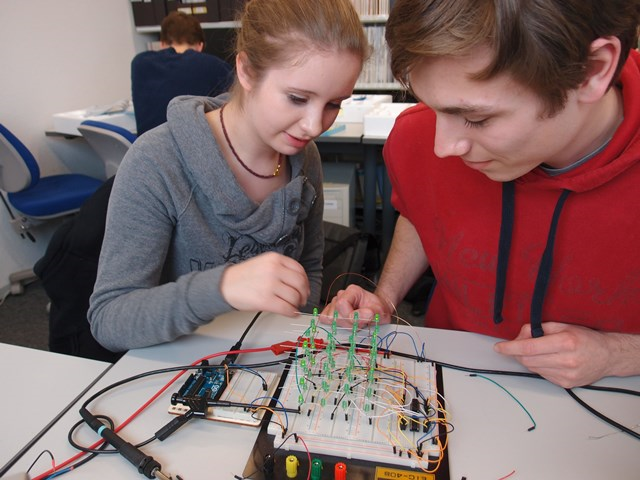
During the internship, they examine simple basic transistor circuits using a Kosmos experiment kit and design and simulate digital circuits. They also develop and programme Lego Mindstorms robots.
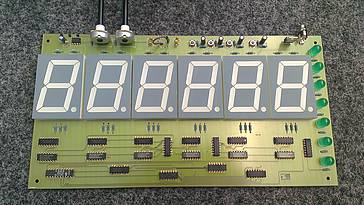
As part of the internship, they develop their own circuit board, including all the necessary steps from design to production. After the design phase, the board is assembled with all the necessary components and programmed according to the task specifications. By the end of the internship, they will have developed and programmed a functional circuit board car based on an Arduino. This practical experience provides valuable knowledge and skills in the fields of electrical engineering and computer science.
Furthermore, researchers also present current projects at the IMS to the interns.
Just over a year ago, Robin was still an intern with us – now he is studying electrical engineering/microelectronics at Leibniz University Hannover in the 2011/2012 winter semester.
We wish him every success and enjoyment in his studies.
Hello,
My name is Christian Lange and I am a Year 10 pupil at Gymnasium Adolfinum Bückeburg.
In autumn 2011, I attended a two-week internship at the Institute for Microelectronic Systems, Department of Architectures and Systems. During this time, I learned a great deal about the structure and significance of processors, flip-flops and logic gates, for example. In a very interesting lecture, I learned a lot of new things about MP3 encoding and JPEG and MPEG encoding, as well as about career opportunities in electrical engineering. I learned how to design a circuit board with EAGLE, how to assemble it and how to program a microcontroller (with C). This is very useful to me personally, as I can also use these procedures for my hobby projects.
I recommend this internship to anyone who wants to learn more about electrical engineering and microcontrollers. I learned a lot. Thank you again!
Hello,
Our names are Julian, Jonah and Josephine. We each completed a two-week internship at the Institute for Microelectronic Systems. During this time, we were given a wide range of insights into the field of microelectronics, which was always very practical. We were allowed to try out many things on our own, but the staff were always on hand to help us. To make the topics even easier to understand, there were also many PowerPoint presentations. In addition, we were introduced to current, very interesting projects at the institute. We particularly enjoyed working on the computers, because there we were able to gain an even clearer understanding of the technologies and their uses with various simulation programmes. So it was never boring, and despite all the snow, we didn't have to shovel it. With the help of the knowledge we gained, we were able to solder a circuit board at the end. Only Julian was able to programme a game with the help of his prior knowledge in this area, but even soldering the various small parts was very interesting.
All in all, we consider the internship to have been a very positive experience, as everything was explained to us in great detail in a variety of ways and we learned a lot of new things. This internship is therefore also something for you if you don't know much about microelectronics yet! The coffee and cake breaks with the friendly staff are also very nice :-)
Hello,
My name is Enver Karincali and I am in Year 10 at Kurt Schwitters Grammar School in Misburg. From 18 to 29 January 2010, I did an internship at the Institute for Microelectronic Systems in the field of architectures and systems, and I am thrilled by the broad spectrum covered by this area. I designed digital circuits on the computer, conducted experiments with the Kosmoskasten, and even soldered my own Pac Man circuit board, which I can use as a video game on my television at home. I was also introduced to the many projects being worked on by the staff. I really enjoyed the internship and was able to make good use of the two weeks. I could definitely imagine studying electrical engineering later on. I would like to thank all the employees once again, especially Mr Bieber, Mr Wiege and Dr Jeschke, who accompanied me throughout the internship.
Hello,
My name is Wilhelm Biniok and I did a two-week internship at IMS.
I mainly developed electronic circuits, for example for the image reproduction of a game console or a traffic light circuit.
I particularly liked the commitment of the employees in supervising my internship.
Hello, my name is Daniel Szambien. I am in Year 11 at Johannes Kepler Gymnasium in Garbsen. From 19 January 2009 to 30 January 2009, I did a two-week internship at the Institute for Microelectronic Systems (IMS) in the field of architectures and systems. I learned a great deal about the various semiconductor components and also designed small digital circuits on my own. In various discussions with Prof. Dr. Blume and his staff, I already gained a good insight into the course of study and the job profile. I was also able to attend a lecture on this subject area. Almost every day, I was introduced to projects that the staff were currently working on. Overall, I can recommend an internship at the IMS to anyone who is interested in either a career as an engineer or this field of study. This internship helped me a lot in choosing a possible career.
Interested students can apply for an internship at any time. The application should include the following documents:
If you have any questions, please contact the person listed below.
In addition to FWJ and school internships, IMS also offers additional programmes for school pupils:
Last Change: 23.04.26